As carbon dioxide removal (CDR) becomes central to corporate net-zero strategies, one question keeps coming up: How do we know that carbon removal is actually happening—and that it’s real, measurable, and durable?
What is MRV?
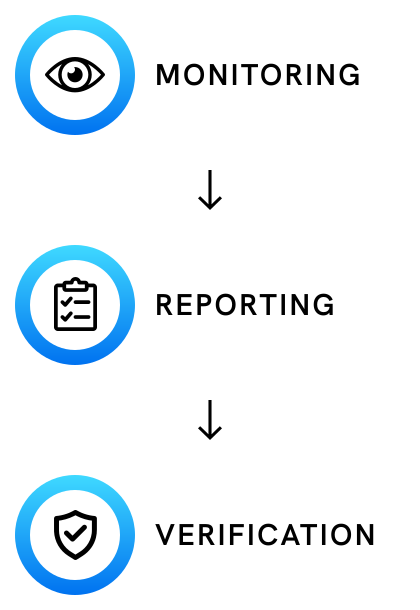
In carbon removal, MRV—Monitoring, Reporting, and Verification—refers to the set of processes and protocols used to track, report, and verify the amount of CO₂ removed from the atmosphere and stored away durably. MRV is the foundation for credible climate claims and the trust layer that enables carbon markets to grow with integrity.
MRV is how we ensure that a tonne of CO₂ claimed as “removed” was actually:
- Captured from the atmosphere
- Accounted for transparently
- Verified by an independent third party
- Stored durably, in line with best available science
Only when the dataset is complete and independently verified, confirming that removal has occurred and meets quality and durability thresholds, can a carbon removal credit be issued. Without MRV, climate claims lack credibility.
Why Digital MRV Matters for Any CDR Project or Purchase
Scaling carbon removal to climate-relevant levels requires more than just ambition - it requires certainty. Certainty that each credit represents actual, permanent CO2 removal, and certainty that buyers, suppliers, and regulators can trust the data behind it. That certainty comes from digital MRV (dMRV).
What digital MRV delivers:
- Credibility & risk mitigation: Verifiable, science‑based data reduces greenwashing, reputational, and counterparty risk.
- Efficiency & speed: Standardized, automated data flows cut admin work and shorten certification/issuance timelines.
- Regulatory readiness: dMRV is the foundation for any high-quality government removal policy, from CRCF certification in the EU (from 2026), to future ETS integrations in the EU, UK, Japan, and beyond.
- Finance enablement: A robust dMRV plan from the start builds early-stage investor confidence to support a positive investment decision; once the project is operational, audit-ready records help unlock long-term offtakes with buyers and secure financing for scale-up or expansion.
How Does Digital MRV Work?
- Data capture — dMRV collects method-specific data, contracts, and chain-of-custody information from suppliers (e.g. via IoT, ERP systems).
- Normalization — dMRV standardizes formats/units across sources and time.
- Quality checks — dMRV runs completeness and consistency checks, flags anomalies, and prompts the supplier to fix issues before submission.
- Net removal calculation — dMRV applies the Standard’s approved methodology to calculate net CO₂ removed, subtracting project and transport emissions (tCO₂e).
- Independent verification — An accredited Validation & Verification Body (VVB), appointed by the Standard (e.g. Carbon Standards International (CSI), Isometric, Puro, or Verra), audits the data directly in the dMRV system and confirms compliance.
- Issuance & registry — The Standard reviews the VVB report, issues traceable carbon removal credits with persistent IDs, and records them in its public registry.